
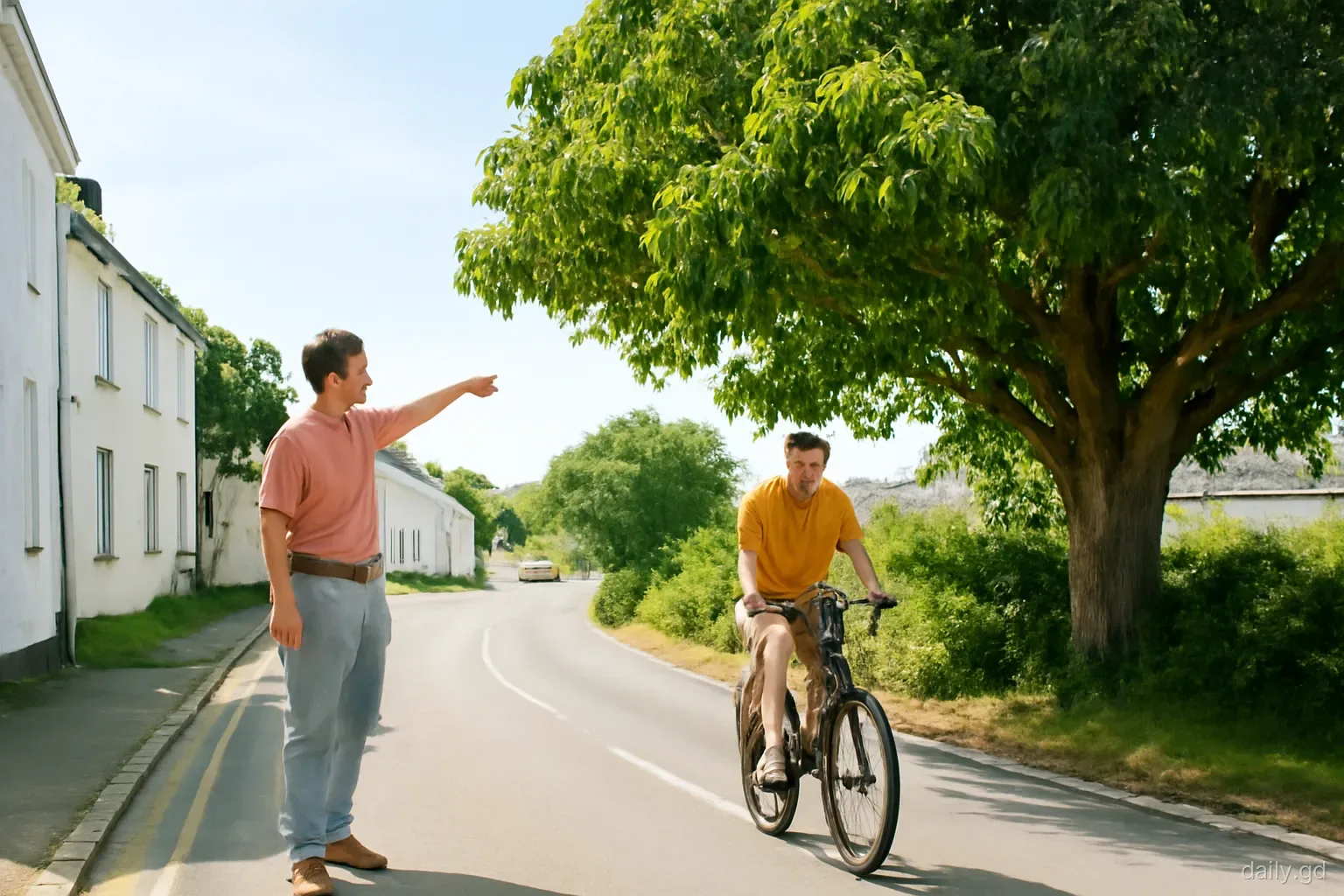
A plumber promises to come "just now". A neighbour explains that the house you want is "up so, by the big mango, pass the church". A friend invites you to a lime "Saturday coming". All three are perfectly clear to a Grenadian and baffling to someone who arrived last month with a phone full of map pins and a habit of booking appointments to the quarter-hour.
Time and place words are where everyday misunderstandings pile up fastest, because the English words look familiar while meaning something slightly different. This guide covers the expressions residents meet most often, how directions really work in a country where most houses have no street number, and the habits that stop you waiting all afternoon or wandering the wrong side of a valley.
Time words that do not mean what you think
Just now. In British English, "just now" means a moment ago. In Grenada it usually means soon, at some point later, and the later can stretch from five minutes to the end of the day. "Right now" is closer to immediately, and "now now" is more urgent still.
Later. Often means later today, and frequently the evening. "Ah go pass by later" from a neighbour typically means after work, not in an hour.
Evening. Evening starts much earlier than in Northern Europe, from mid-afternoon. "Good evening" at four o'clock is normal, and at nightfall people switch to "good night" as a greeting, not a farewell.
Foreday morning. The dark hours before dawn. Market vendors, fishermen and J'ouvert revellers are all foreday morning people.
Monday coming and Sunday gone. Monday coming is next Monday; Sunday gone is last Sunday. People use the pattern with any day, and with months: "August gone" is last August.
Soon come. A cheerful promise to return. It is not a specific time and is not meant as one.
Why timing feels loose, and where it is not
Social events run on a relaxed clock. A fete advertised for nine will be thin before eleven, a birthday lime called for four may start at six, and arriving exactly on time to a private gathering can mean helping to set up the chairs. That is rarely a sign of disrespect; it is simply how social time works across much of the Caribbean.
Plenty of things are punctual, and newcomers who generalise from limes get caught out. Church services generally start close to the stated time. Schools, government offices, banks and medical appointments expect you on time even when you then wait. Funerals start promptly. The first and last route buses on a given route run at roughly the same times every day, and missing the last bus home from St George's is a classic mistake.
The working rule is that formal and institutional time is real, while social and tradesperson time is approximate. When an exact time matters, ask for it in clock terms and say why: "Can you come before eleven? Ah have to leave at twelve."
Directions run on landmarks
Landmarks first. Churches, schools, rum shops, gas stations, police stations, playing fields and big trees are the reference points. Expect directions such as "pass the Anglican church, take the road by the shop, is the green house after the standpipe".
Town and country. "Going town" from most of the island means going to St George's, though in St Andrew's people may mean Grenville. "Country" means rural areas away from the south-west.
Up and down. Up and down often follow the land: up means uphill, inland or higher up a valley; down can mean towards the coast or the main road. "Up so" and "down so", said with a gesture, mean "in that direction", so watch the hand rather than the words.
The gap. A gap is a side road, lane or track leading off a main road, often unpaved. "Take the second gap after the school" is a normal instruction.
The junction and the main road. Most villages are organised around a main road and one or two junctions. Directions usually start from whichever one you are likely to reach first.
Doubling for emphasis. "Straight straight" means keep going a long way without turning. "Up up" means right at the top.
No house number: giving your own address
Many homes, especially outside the south-west, have no street number, and some roads have no official name in daily use. Mail often goes to a post office box or is collected, and deliveries, taxis and visitors rely on descriptions. New residents quickly need a short, reliable way to describe where they live.
A good description starts from something everyone knows, gives one or two turns and ends with something unmistakable about the house: "Coming from Grand Anse, pass the church in the village, take the gap by the blue rum shop, third house on the left, white with a red roof and a breadfruit tree in front." Write it down once and send the same version to every delivery driver, technician and new friend.
For emergencies this matters more than for pizza. If you ever have to call 911, give the parish, the village and the nearest landmark, and if possible send someone to the main road to flag down the ambulance or police. Pinning your location in a messaging app helps friends find you, but responders work best with a clear spoken description as well.
The same description is worth adding to any form that asks for an address, from a utility application to a school registration, beside the official district name. Staff at the electricity and water companies, the post office and banks are used to addresses such as "Upper Morne Jaloux, near the school", and a precise landmark often gets a technician to the right meter faster than a lot number that nobody uses in daily life.
How to follow directions without getting lost
A simple routine saves a lot of turning round in narrow lanes:
- Ask for the landmark nearest the destination, not just the route. "What is right beside the house?" is a useful question.
- Repeat the directions back in your own words; people will correct you happily.
- Ask how long it takes, not how far. Distances are rarely given in kilometres, and "not far" on a hill road can mean twenty minutes on foot.
- Check the name of the village or district you should be in, so you can ask again on the way. Residents expect to be asked and will usually point you on.
- If you are driving, ask whether the road is good for your car. Some gaps are fine for a pickup and miserable for a low saloon after rain.
- Save the description and the landmarks for next time, especially for houses you visit after dark.
Arranging tradespeople, deliveries and appointments
Most residents meet the gap between social time and clock time when they need something fixed. An electrician, plumber or appliance technician who says he will come "tomorrow" may mean tomorrow if the job before yours goes smoothly, and the day after if it does not. This is rarely carelessness: many tradespeople work alone, depend on route buses or a shared vehicle, and juggle more jobs than they can schedule precisely.
Three habits help. Agree a window rather than a time, and ask whether morning or afternoon is more likely. Send a short message on the day to confirm, which also tells you early if plans have changed. And give the landmark description of your house in the same message, so a delayed technician is not also a lost one.
For deliveries from shops in the south, expect to be called or messaged when the driver is near, and to be asked to wait at the main road or a known shop if your lane is hard to find or unsuitable for a lorry. Being reachable by phone at that moment matters more than the exact hour you were promised.
Frequently asked questions
What does 'just now' mean in Grenada?
It usually means soon or later on, not a moment ago. The actual delay can be short or long. If timing matters, ask for a clock time politely, or explain your own deadline so the other person can tell you honestly whether it will work.
Do houses in Grenada have street addresses?
Some do, particularly in planned developments and parts of the south, but many do not, and even where an address exists people describe locations by landmarks. Residents keep a standard description of their home for deliveries, taxis and emergency services.
What is a 'gap' in Grenadian directions?
A gap is a side road, lane or track that leaves a main road, often narrow and sometimes unpaved. Directions such as 'take the gap after the school' are common, and gaps are often known by a family or shop near the entrance.
Is it rude to arrive on time to a Grenadian party?
Not rude, just early. Social gatherings often start well after the stated time, so arriving on the hour may find the host still cooking. For church, funerals, appointments and anything formal, arrive on time as you would anywhere.
What does 'Saturday coming' mean?
It means next Saturday, the coming one. The opposite pattern, 'Saturday gone', means last Saturday. Both work with any day of the week and with months, and they are used across all ages.
How do you give directions to an ambulance in Grenada?
Call 911, state the parish and village first, then the nearest well-known landmark such as a church, school or shop, and the route from the main road. If possible, send someone to stand at the main road to guide the vehicle in.